Technology priorities are changing faster than traditional project models can sometimes accommodate.
An AI use case that looks promising today may need to change after two weeks of real-world testing. A modernization initiative can expose an entirely different constraint once engineers get into the environment. A business requirement that seemed clear in a planning session can look very different once users interact with the solution.
That does not mean traditional project delivery is going away.
When the problem is well understood, requirements are relatively stable, the desired end state is clear, and the path to implementation is predictable, a structured project model remains one of the most effective ways to execute.
But what happens when an organization has a pressing technical challenge, but the business outcome and the right solution still need to be clarified?
That requires a different approach.
At River Point Technology (RPT), we are introducing Forward Deployed Units (FDUs) as an evolution of our existing flexible delivery approach for challenges that require concentrated discovery, experimentation, and validation: small, multidisciplinary teams that work directly alongside customers to rapidly understand problems, build and test solutions, and iterate based on real-world feedback.
The goal is not simply to move faster.
It is to create a tighter loop between business needs, technical execution, customer feedback, and measurable outcomes.
Because when the problem is evolving, the delivery model needs to evolve with it.
Matching the Delivery Approach to the Level of Uncertainty
Project delivery can combine structure with discovery, iteration, and customer feedback. At RPT, that flexibility is already part of our approach.
The distinction is how much uncertainty remains around the problem, the solution, and the expected value — and how the engagement show be organized to resolve it.
But emerging technology increasingly presents organizations with a different kind of challenge.
Sometimes you cannot fully understand the problem until you start solving it.
AI is an obvious example.
An organization may identify a promising AI use case, but questions around data readiness, workflow integration, governance, security, user behavior, and actual business value may not become clear until a working solution is introduced into the environment.
The same dynamic can occur across cloud modernization, platform engineering, automation, application transformation, and other complex initiatives.
Architecture diagrams, discovery sessions, and requirements documents can tell you a lot. They cannot tell you everything you will learn from putting something real in front of the people who need to use it.
The longer that feedback loop takes, the longer the organization may invest against assumptions that have not yet been validated.
That is where forward deployment changes the model.
Forward Deployment Changes the Feedback Loop
A Forward Deployed Unit brings the capabilities needed to understand and solve the problem together in a small, focused team.
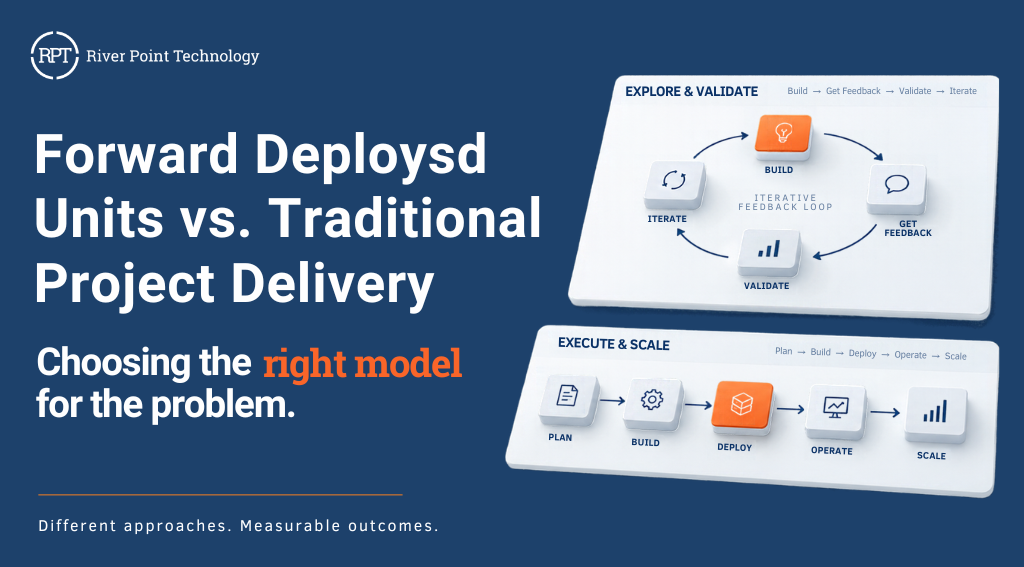
Rather than separating strategy, discovery, engineering, and implementation into long sequential phases, the FDU works directly alongside the customer to understand the environment, identify the highest-value opportunity, build something usable, put it into practice, measure what happens, and adjust.
The loop becomes:
Understand → Build → Deploy → Learn → Adapt → Scale
And critically, those steps are not separated by months.
Instead of attempting to eliminate uncertainty before execution begins, the team uses execution to systematically reduce uncertainty.
That distinction matters.
Moving quickly is not valuable if you are moving quickly in the wrong direction. The value of forward deployment comes from combining speed with continuous learning and validation.
FDUs Aren’t the Answer to Every Problem
Forward Deployed Units are not intended to replace traditional project delivery at RPT.
They are another delivery model we offer — and choosing the right approach depends on the nature of the problem we are solving with a customer.
A defined implementation is often the right fit when:
- The problem and desired solution are well understood.
- Requirements can be reasonably defined upfront.
- Scope and deliverables are relatively predictable.
- Established technologies or implementation patterns exist.
- Dependencies and timelines can be planned with confidence.
- The organization is ready to execute against a defined solution.
Many initiatives fall between a repeatable implementation and open-ended exploration. An adaptive project approach works well when the overall objective and scope are sufficiently clear to plan the engagement, while requirements and technical decisions evolve through discovery and feedback.
A Forward Deployed Unit may be the better fit when:
- The business problem warrants focused exploration, but the solution or its feasibility remains materially uncertain.
- Requirements are likely to change as the organization learns.
- New technology, architecture, or use cases need to be validated.
- Technical or organizational unknowns are likely to surface during execution.
- Rapid feedback from users or stakeholders is critical.
- The organization needs to prove measurable value before committing to broader scale.
Neither approach is inherently better.
The right delivery model is the one that matches the problem.
That distinction is important because not every transformation initiative needs experimentation. Sometimes the fastest path to value is simply disciplined execution against a known plan.
Other times, the biggest risk is committing too early to a solution before enough has been learned.
From Unknowns to a Repeatable Path
Forward deployed and traditional project models do not have to exist independently.
In fact, they can be particularly powerful when used together.
An FDU may begin with a business problem where the organization has a clear desired outcome but significant uncertainty around how to achieve it.
The team can rapidly explore the problem, test assumptions, build a working solution, gather real-world feedback, and establish whether the approach creates measurable value.
As uncertainty decreases, the nature of the work changes.
What began as an ambiguous problem can become a validated solution with clearer requirements, architecture, dependencies, resources, and expected outcomes.
At that point, the work may transition into a more traditional project structure designed to operationalize and scale what has already been proven.
High uncertainty → Forward Deployed Unit → Validated solution → Structured delivery → Scale
The reverse can happen as well.
A traditional project may uncover a particularly difficult technical or business problem that cannot be resolved simply by executing against the original plan. A focused FDU can be deployed against that specific problem, learn quickly, establish a path forward, and then feed that solution back into the larger initiative.
The objective is not to force every engagement into one methodology.
It is to use the right delivery model at the right time.
From Deliverables to Outcomes
Forward deployment also changes how teams think about success.
Traditional projects are often structured around clearly defined deliverables: complete the assessment, implement the platform, migrate the workloads, automate the process, or deliver the training.
Those outputs matter.
But when the path forward is uncertain, completing a predetermined list of deliverables does not necessarily mean the organization achieved the business outcome that initiated the work.
Outcome alignment should begin during sales and discovery, regardless of the delivery model. Customers often engage through teams focused on immediate technical needs, and the connection to a broader business priority may not yet be explicit.
Without that alignment, delivery teams can be left to identify the intended outcome during execution—or reconstruct it when preparing for closure and handoff.
Before delivery begins, the customer, sales team, and delivery team should agree on what needs to improve, why it matters, who owns the outcome, and how progress will be measured. When tactical stakeholders cannot validate the business priority, that conversation should include the appropriate business sponsor.
An FDU carries that shared outcome into each iteration, using evidence to refine the solution and priorities. The outcome can evolve as the team learns, but it should not be defined only after the work is complete.
That could mean reducing the time required to provision infrastructure. Moving an AI use case from concept into production. Eliminating a manual workflow. Improving developer productivity. Reducing operating costs. Increasing adoption. Or enabling an entirely new customer or employee experience.
The technology is a means to that outcome — not the outcome itself.
That philosophy aligns with RPT’s broader approach to technology transformation. Our Value Creation
Technology methodology is built around connecting technology investment to measurable business impact and creating smaller wins that can ultimately scale into larger outcomes. River Point Technology
Forward deployment puts that principle directly into the delivery model.
Why Small, Multidisciplinary Teams Matter
An FDU is intentionally small.
That does not mean every FDU has the same structure. The composition should reflect the problem being solved.
Depending on the engagement, that could mean bringing together expertise across product, strategy, architecture, engineering, AI, cloud, security, DevOps, organizational change, or other disciplines.
The goal is to assemble the smallest team capable of taking a problem from ambiguity to a working solution.
Why?
Because every handoff introduces distance.
Business teams explain the problem to consultants. Consultants translate it for architects. Architects translate it for engineers. Engineers build something that eventually makes its way back to the business for validation.
An embedded, multidisciplinary team compresses that cycle.
The people understanding the business problem work closely with the people building the solution — and both stay close enough to the customer to see whether it is actually working.
Forward Deployed Does Not Mean Permanently Deployed
There is another important distinction.
The goal of an FDU should not be to create permanent dependency on an external team.
A successful Forward Deployed Unit should leave the organization more capable than it was when the engagement began.
That means establishing the solution, documenting repeatable patterns, transferring knowledge, enabling internal teams, and creating the foundation required to operate and scale what has been built.
This is particularly important with emerging technology.
Organizations do not just need someone who can build the next AI solution or implement the next platform. They need the architecture, governance, operating practices, capabilities, and internal knowledge required to continue evolving after the initial engagement ends.
That fits RPT’s existing emphasis on supporting customers from strategy through Day 2 and helping organizations realize lasting value from their technology investments.
The FDU accelerates the path to the first meaningful outcome.
Enablement helps make that outcome sustainable.
A Different Model for a Different Kind of Problem
The technology landscape is not becoming more predictable.
AI capabilities are advancing rapidly. Enterprise architectures are becoming more complex. Security and governance requirements continue to evolve. And business leaders increasingly expect technology investments to demonstrate measurable value, not simply deliver technical outputs.
Some of those challenges will be best addressed through traditional project delivery.
Others will not.
The question organizations should ask is not:
Should we use an FDU or a traditional project model?
It is:
How much do we know about the problem, how much do we know about the solution, and what delivery model will get us to measurable value with the least unnecessary risk?
When the destination and path are clear, execute.
When the outcome needs clarification, align first. When the solution remains uncertain, build and learn.
And when that learning produces a repeatable solution, scale it.
That is the role of the Forward Deployed Unit.
Not to replace traditional consulting.
Not to remove planning, governance, or disciplined execution.
But to give organizations a different way to solve the problems that cannot be fully defined before the work begins.
Understand the problem. Build. Learn. Adapt. Measure the outcome. Then scale what works.
Is Your Initiative Ready for an FDU?
If you have a clearly defined project with known requirements and an established implementation path, a traditional delivery model may be exactly what you need.
If you have a high-value business problem but are still working through what the right solution looks like, a
Forward Deployed Unit may provide a faster path from uncertainty to a validated solution.
River Point Technology works with enterprise organizations to determine the right approach for both — combining strategy, engineering, implementation, and enablement to move from technology investment to measurable business outcomes.
Talk to River Point Technology about your next initiative