Technology priorities are changing faster than traditional project models can sometimes accommodate.
An AI use case that looks promising today may need to change after two weeks of real-world testing. A modernization initiative can expose an entirely different constraint once engineers get into the environment. A business requirement that seemed clear in a planning session can look very different once users interact with the solution.
That does not mean traditional project delivery is going away.
When the problem is well understood, requirements are relatively stable, the desired end state is clear, and the path to implementation is predictable, a structured project model remains one of the most effective ways to execute.
But what happens when an organization has a pressing technical challenge, but the business outcome and the right solution still need to be clarified?
That requires a different approach.
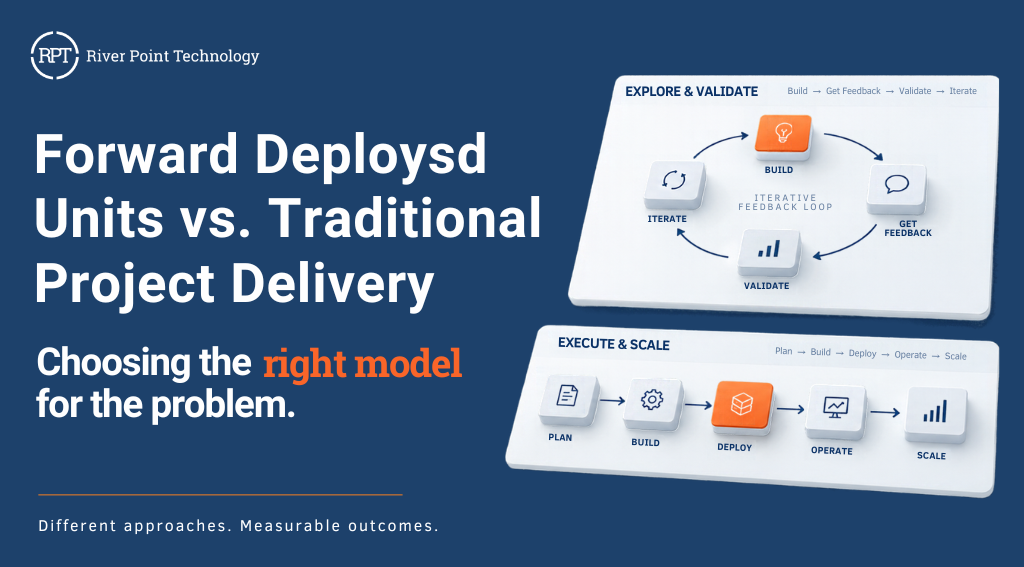
At River Point Technology (RPT), we are introducing Forward Deployed Units (FDUs) as an evolution of our existing flexible delivery approach for challenges that require concentrated discovery, experimentation, and validation: small, multidisciplinary teams that work directly alongside customers to rapidly understand problems, build and test solutions, and iterate based on real-world feedback.
The goal is not simply to move faster.
It is to create a tighter loop between business needs, technical execution, customer feedback, and measurable outcomes.
Because when the problem is evolving, the delivery model needs to evolve with it.
Matching the Delivery Approach to the Level of Uncertainty
Project delivery can combine structure with discovery, iteration, and customer feedback. At RPT, that flexibility is already part of our approach.
The distinction is how much uncertainty remains around the problem, the solution, and the expected value — and how the engagement show be organized to resolve it.
But emerging technology increasingly presents organizations with a different kind of challenge.
Sometimes you cannot fully understand the problem until you start solving it.
AI is an obvious example.
An organization may identify a promising AI use case, but questions around data readiness, workflow integration, governance, security, user behavior, and actual business value may not become clear until a working solution is introduced into the environment.
The same dynamic can occur across cloud modernization, platform engineering, automation, application transformation, and other complex initiatives.
Architecture diagrams, discovery sessions, and requirements documents can tell you a lot. They cannot tell you everything you will learn from putting something real in front of the people who need to use it.
The longer that feedback loop takes, the longer the organization may invest against assumptions that have not yet been validated.
That is where forward deployment changes the model.
Forward Deployment Changes the Feedback Loop
A Forward Deployed Unit brings the capabilities needed to understand and solve the problem together in a small, focused team.
Rather than separating strategy, discovery, engineering, and implementation into long sequential phases, the FDU works directly alongside the customer to understand the environment, identify the highest-value opportunity, build something usable, put it into practice, measure what happens, and adjust.
The loop becomes:
Understand → Build → Deploy → Learn → Adapt → Scale
And critically, those steps are not separated by months.
Instead of attempting to eliminate uncertainty before execution begins, the team uses execution to systematically reduce uncertainty.
That distinction matters.
Moving quickly is not valuable if you are moving quickly in the wrong direction. The value of forward deployment comes from combining speed with continuous learning and validation.
FDUs Aren’t the Answer to Every Problem
Forward Deployed Units are not intended to replace traditional project delivery at RPT.
They are another delivery model we offer — and choosing the right approach depends on the nature of the problem we are solving with a customer.
A defined implementation is often the right fit when:
- The problem and desired solution are well understood.
- Requirements can be reasonably defined upfront.
- Scope and deliverables are relatively predictable.
- Established technologies or implementation patterns exist.
- Dependencies and timelines can be planned with confidence.
- The organization is ready to execute against a defined solution.
Many initiatives fall between a repeatable implementation and open-ended exploration. An adaptive project approach works well when the overall objective and scope are sufficiently clear to plan the engagement, while requirements and technical decisions evolve through discovery and feedback.
A Forward Deployed Unit may be the better fit when:
- The business problem warrants focused exploration, but the solution or its feasibility remains materially uncertain.
- Requirements are likely to change as the organization learns.
- New technology, architecture, or use cases need to be validated.
- Technical or organizational unknowns are likely to surface during execution.
- Rapid feedback from users or stakeholders is critical.
- The organization needs to prove measurable value before committing to broader scale.
Neither approach is inherently better.
The right delivery model is the one that matches the problem.
That distinction is important because not every transformation initiative needs experimentation. Sometimes the fastest path to value is simply disciplined execution against a known plan.
Other times, the biggest risk is committing too early to a solution before enough has been learned.
From Unknowns to a Repeatable Path
Forward deployed and traditional project models do not have to exist independently.
In fact, they can be particularly powerful when used together.
An FDU may begin with a business problem where the organization has a clear desired outcome but significant uncertainty around how to achieve it.
The team can rapidly explore the problem, test assumptions, build a working solution, gather real-world feedback, and establish whether the approach creates measurable value.
As uncertainty decreases, the nature of the work changes.
What began as an ambiguous problem can become a validated solution with clearer requirements, architecture, dependencies, resources, and expected outcomes.
At that point, the work may transition into a more traditional project structure designed to operationalize and scale what has already been proven.
High uncertainty → Forward Deployed Unit → Validated solution → Structured delivery → Scale
The reverse can happen as well.
A traditional project may uncover a particularly difficult technical or business problem that cannot be resolved simply by executing against the original plan. A focused FDU can be deployed against that specific problem, learn quickly, establish a path forward, and then feed that solution back into the larger initiative.
The objective is not to force every engagement into one methodology.
It is to use the right delivery model at the right time.
From Deliverables to Outcomes
Forward deployment also changes how teams think about success.
Traditional projects are often structured around clearly defined deliverables: complete the assessment, implement the platform, migrate the workloads, automate the process, or deliver the training.
Those outputs matter.
But when the path forward is uncertain, completing a predetermined list of deliverables does not necessarily mean the organization achieved the business outcome that initiated the work.
Outcome alignment should begin during sales and discovery, regardless of the delivery model. Customers often engage through teams focused on immediate technical needs, and the connection to a broader business priority may not yet be explicit.
Without that alignment, delivery teams can be left to identify the intended outcome during execution—or reconstruct it when preparing for closure and handoff.
Before delivery begins, the customer, sales team, and delivery team should agree on what needs to improve, why it matters, who owns the outcome, and how progress will be measured. When tactical stakeholders cannot validate the business priority, that conversation should include the appropriate business sponsor.
An FDU carries that shared outcome into each iteration, using evidence to refine the solution and priorities. The outcome can evolve as the team learns, but it should not be defined only after the work is complete.
That could mean reducing the time required to provision infrastructure. Moving an AI use case from concept into production. Eliminating a manual workflow. Improving developer productivity. Reducing operating costs. Increasing adoption. Or enabling an entirely new customer or employee experience.
The technology is a means to that outcome — not the outcome itself.
That philosophy aligns with RPT’s broader approach to technology transformation. Our Value Creation
Technology methodology is built around connecting technology investment to measurable business impact and creating smaller wins that can ultimately scale into larger outcomes. River Point Technology
Forward deployment puts that principle directly into the delivery model.
Why Small, Multidisciplinary Teams Matter
An FDU is intentionally small.
That does not mean every FDU has the same structure. The composition should reflect the problem being solved.
Depending on the engagement, that could mean bringing together expertise across product, strategy, architecture, engineering, AI, cloud, security, DevOps, organizational change, or other disciplines.
The goal is to assemble the smallest team capable of taking a problem from ambiguity to a working solution.
Why?
Because every handoff introduces distance.
Business teams explain the problem to consultants. Consultants translate it for architects. Architects translate it for engineers. Engineers build something that eventually makes its way back to the business for validation.
An embedded, multidisciplinary team compresses that cycle.
The people understanding the business problem work closely with the people building the solution — and both stay close enough to the customer to see whether it is actually working.
Forward Deployed Does Not Mean Permanently Deployed
There is another important distinction.
The goal of an FDU should not be to create permanent dependency on an external team.
A successful Forward Deployed Unit should leave the organization more capable than it was when the engagement began.
That means establishing the solution, documenting repeatable patterns, transferring knowledge, enabling internal teams, and creating the foundation required to operate and scale what has been built.
This is particularly important with emerging technology.
Organizations do not just need someone who can build the next AI solution or implement the next platform. They need the architecture, governance, operating practices, capabilities, and internal knowledge required to continue evolving after the initial engagement ends.
That fits RPT’s existing emphasis on supporting customers from strategy through Day 2 and helping organizations realize lasting value from their technology investments.
The FDU accelerates the path to the first meaningful outcome.
Enablement helps make that outcome sustainable.
A Different Model for a Different Kind of Problem
The technology landscape is not becoming more predictable.
AI capabilities are advancing rapidly. Enterprise architectures are becoming more complex. Security and governance requirements continue to evolve. And business leaders increasingly expect technology investments to demonstrate measurable value, not simply deliver technical outputs.
Some of those challenges will be best addressed through traditional project delivery.
Others will not.
The question organizations should ask is not:
Should we use an FDU or a traditional project model?
It is:
How much do we know about the problem, how much do we know about the solution, and what delivery model will get us to measurable value with the least unnecessary risk?
When the destination and path are clear, execute.
When the outcome needs clarification, align first. When the solution remains uncertain, build and learn.
And when that learning produces a repeatable solution, scale it.
That is the role of the Forward Deployed Unit.
Not to replace traditional consulting.
Not to remove planning, governance, or disciplined execution.
But to give organizations a different way to solve the problems that cannot be fully defined before the work begins.
Understand the problem. Build. Learn. Adapt. Measure the outcome. Then scale what works.
Is Your Initiative Ready for an FDU?
If you have a clearly defined project with known requirements and an established implementation path, a traditional delivery model may be exactly what you need.
If you have a high-value business problem but are still working through what the right solution looks like, a
Forward Deployed Unit may provide a faster path from uncertainty to a validated solution.
River Point Technology works with enterprise organizations to determine the right approach for both — combining strategy, engineering, implementation, and enablement to move from technology investment to measurable business outcomes.
Talk to River Point Technology about your next initiative
Security teams face a familiar challenge: identifying an exposed credential is only the first step. Once a secret is detected, organizations need a reliable way to assess the issue, determine the appropriate response, remediate the credential, and communicate what happened.
This is where automation can help bridge the gap between detection and remediation.
In its IBM TechXchange session, River Point Technology explores how technologies including HashiCorp Vault Radar, Vault, IBM watsonx Orchestrate, and Terraform can work together to support a more connected approach to security response and infrastructure automation.
Moving Beyond Detection
Secrets can be unintentionally exposed in source code repositories, creating potential security risks for organizations. Traditional response processes may require several manual steps: identifying the affected credential, determining its impact, rotating or revoking it, updating dependent systems, and notifying the appropriate teams.
A more integrated approach can connect these activities into a coordinated workflow.
The concept explored by River Point Technology follows a simple progression:
Detect → Assess → Remediate → Notify
The objective is not simply to generate another security alert, but to create a process that can move a finding toward meaningful action.
Connecting Security and Automation
Vault Radar can help identify exposed secrets across source code repositories and other environments. Once a potential exposure is identified, orchestration capabilities can help determine what actions should follow.
IBM watsonx Orchestrate can support the coordination of tasks within an automated workflow, while HashiCorp Vault provides capabilities for managing and protecting secrets and credentials.
Infrastructure automation tools such as Terraform can then support changes required across dependent infrastructure and services.
When these capabilities are connected, organizations can establish a more consistent process for responding to security findings while reducing reliance on disconnected, manual steps.
The Role of AI Agents in Security Operations
The discussion also highlights the growing role of AI agents and agentic automation in enterprise environments.
Implementing an AI-driven workflow requires more than selecting a technology. Organizations must consider how agents fit within their existing architecture, where they can provide meaningful value, how their performance should be measured, and which processes are appropriate for automation.
Questions around feasibility, architecture, agent development, governance, and key performance indicators (KPIs) are therefore important considerations when designing agent-enabled workflows.
From Security Finding to Action
Effective security operations depend not only on identifying potential threats, but also on having the processes and technologies needed to respond.
By connecting security detection, intelligent orchestration, secrets management, and infrastructure automation, organizations can create workflows designed to move more efficiently from a security finding to remediation.
The combination of Vault Radar, Vault, watsonx Orchestrate, and Terraform provides one example of how these capabilities can be brought together to support automated security response.
Explore the Approach
River Point Technology’s “From Detection to Remediation with Vault Radar, Vault, watsonx Orchestrate & Terraform” session will explore this approach in greater detail, including the role of AI agents, workflow architecture, and automated remediation.
Speakers:
• Brian McDonald — Principal Solutions Architect, River Point Technology
• Ryan Butler — Customer Success Lead, River Point Technology
Session: From Detection to Remediation with Vault Radar, Vault, watsonx Orchestrate & Terraform [TEC-2559]
River Point Technology helps organizations navigate cloud, automation, security, and modern infrastructure challenges with practical technology strategies and solutions.
Why Yesterday’s Guardrails Won’t Hold Tomorrow’s Agents
Some organizations are not new to credential risk at scale. They have run HashiCorp Vault in production for years. They have retired static secrets, automated rotation, and built centers of excellence around identity and access. If your AI governance pitch to an infrastructure-mature enterprise starts with “here is how to manage secrets at scale,” you have already lost the room.
The real gap for these organizations is not scale. It is speed. AI-operational enterprises have mastered running infrastructure at enterprise volume. What they have not mastered is governing decisions made by autonomous agents at machine speed, where a workflow can act, escalate, and move on before a human ever sees it.
That gap is the actual conversation infrastructure-mature organizations want to have right now. Here is what it takes to have it well.
Maturity is Assumed
Organizations that have been operating at scale for years do not need a primer on why credentials should not be hardcoded. They built that discipline a long time ago. Positioning a security conversation around static or even dynamic secrets treats a highly mature buyer like a beginner, and mature buyers disengage fast when that happens.
The more useful frame acknowledges what the organization has already built, then asks the next question: your governance framework was designed for infrastructure that people configure. Is it built for infrastructure that agents operate?
That reframe changes the entire conversation. Instead of “how do you protect secrets,” the question becomes “how do you govern autonomous decisions.” Those are different problems with different failure modes, and most governance frameworks in production today were never designed for the second one.
The Governance Gap Is Architectural, Not Procedural
Infrastructure-mature enterprises already run committees for risk, compliance, and architectural review. The instinct is to assume agentic AI just needs another line item on an existing checklist. It does not.
Agent-driven workflows introduce a different risk surface:
Decision velocity outpaces human review. An agent operating at enterprise scale is not making one decision a human can audit in real time. It is making millions. Governance has to be designed into the architecture, not layered on as a review step after the fact.
Just-in-time credentials are necessary but not sufficient. Dynamic, short-lived credentials issued through HashiCorp Vault reduce blast radius when an agent is compromised or misbehaves. But credential hygiene alone does not answer the harder question: what is this agent authorized to decide, and how do you prove it stayed within that boundary after the fact?
Auditability has to be built for replay, not just logging. When a regulator, auditor, or board member asks “walk us through what the agent decided and why,” a log file is not an answer. Event-driven auditability, the kind that platforms like Confluent are built for, lets an organization reconstruct an agent’s decision path end to end. That reconstruction is the actual compliance artifact, not the fact that logging existed.
Vault is now an architectural decision, not an infrastructure one. Treating HashiCorp Vault as a secrets vault undersells what it does in an agentic environment. The real question it answers is how you design workflows so that a compromised or misbehaving agent has the smallest possible blast radius by design, not by luck.
What “Mature” Looks Like for a Governance Conversation
The instinct with a sophisticated buyer is to assume they need less explanation. The opposite is closer to true: they need a more specific one.
A useful governance conversation with an infrastructure-mature organization covers three concrete pillars, not a generic AI risk overview:
- An enterprise AI architecture north star. Does the organization have a defined end state for where agent autonomy is heading, whether that is autonomous engineering operations, an advisory layer for a customer-facing function, or something narrower? Without a stated target, governance conversations default to reactive risk management instead of proactive design.
- AIOps maturity at machine speed. Traditional observability answers “what happened.” Machine-speed observability has to answer “what is this agent about to do, and should it be allowed to.” That is a different tooling and process requirement, and most organizations have not built it yet even when their infrastructure observability is excellent.
- Automation as a discipline, not a toolset. Declarative, immutable infrastructure is the foundation that makes governance enforceable instead of aspirational. An organization that has already invested in open-source infrastructure automation is closer than it thinks, but the transition to enterprise-grade tooling often becomes necessary exactly when agent autonomy increases, because the guardrails need to be provable, not just present.
Lead With the Pain Point, Not the Product
The strongest version of this conversation never opens with a product name. It opens with a question: where do you feel the pain in AI governance today? Is it FinOps and token economics? Is it security and root-of-trust strategy? Is it operational visibility once agents start making autonomous decisions?
The product conversation comes second, and it comes framed around the pain the buyer already named. A Terraform-driven, cost-aware architecture is a stronger pitch after a FinOps pain point has been established than as an opener. The same is true of Vault’s dynamic identity model after a root-of-trust conversation, or Confluent’s event streaming after an auditability conversation. Sequence matters as much as content.
The Regulatory Reality Nobody Wants to Say Out Loud
Regulators and internal audit functions are not proactively enforcing AI governance standards today. They are reactive: they show up after something goes wrong, ask what framework was followed, and expect a specific answer. That dynamic means organizations that build a defensible governance model now are the ones with an answer ready when, not if, that question comes.
This is also where the acknowledgment matters most. Infrastructure-mature enterprises are not starting from zero. They already have governance committees, architectural review boards, and risk frameworks in place. The gap is not the absence of governance. It is that yesterday’s governance frameworks were built for yesterday’s infrastructure, and agents change the assumptions those frameworks were built on.
The Takeaway for AI-Operational Organizations
If your organization has already retired static secrets, automated credential rotation, and built a mature root-of-trust strategy, the next governance conversation is not about doing more of the same, faster. It is about redesigning governance for a system that makes autonomous decisions instead of one that simply executes configured instructions.
That distinction, more than any single tool, is what separates organizations that are ready for the next wave of agentic AI from those that are patching yesterday’s framework onto tomorrow’s workload.
River Point Technology works with infrastructure-mature enterprises to translate AI governance strategy into deployable architecture, combining HashiCorp Vault’s identity and access model with the broader IBM ecosystem for auditability, cost governance, and compliance. Explore RPT’s approach to security and compliance, or connect with our team to assess where your current governance model has gaps your infrastructure has already outgrown.
Kevin Hospodar is Sr. Director of Go-To-Market at River Point Technology, where he leads go-to-market strategy across sales, marketing, and partnerships for RPT’s HashiCorp and IBM practices. He works closely with AI-operational enterprises navigating the shift from infrastructure automation to agentic AI governance. Connect with him on LinkedIn.