Ninety-two percent of organizations reported an AI-related breach and lacked proper AI access controls. That number, from IBM’s 2026 Cost of Data Breach Report, should stop every technology leader mid-scroll. It is not a story about AI failing to deliver value. It is a story about AI outrunning the guardrails built to manage it.
Here is the paradox we see with nearly every client conversation right now: the appetite for AI has never been higher, and the ability to operationalize it has never been more strained. Thirty-four percent of companies are using AI to transform their business, according to Deloitte’s 2026 AI Report. But Forrester’s State of AI 2025 Report puts the number that successfully moves from experimentation into production at just 10-15%. Gartner goes further: half of all generative AI projects are abandoned after proof of concept, killed by poor data quality, inadequate risk controls, escalating costs, or unclear business value.
Those are not technology problems. They are readiness problems. And readiness is exactly where River Point Technology (RPT) has built its AI practice.
This post breaks down what the data says about the current state of enterprise AI, why so many initiatives stall between pilot and production, and how RPT’s AI Developer Lifecycle Platform is designed to close that gap for our clients.
The Adoption Gap Is Not About Ambition
Enterprises are not short on AI ambition. They are short on AI operating models.
Deloitte’s quarterly survey of 2,800 C-suite executives found that only 25% feel prepared to manage AI governance and risk. That gap between adoption intent and operational readiness is where most AI budgets go to die. Teams stand up a pilot, get a working agent or model in front of stakeholders, and then hit a wall: no defined access controls, no clear model service catalog, no repeatable path from a single prototype to a fleet of agents running across production environments.
Three data points from the current research make the shape of the problem specific:
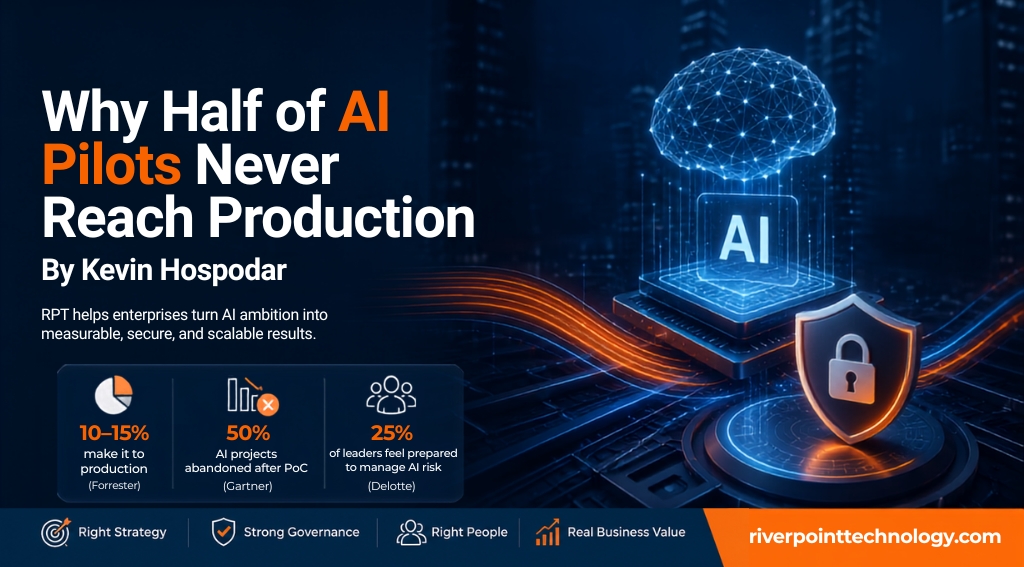
- 10-15% of organizations successfully move AI initiatives from experimentation into production (Forrester, State of AI 2025).
- 50% of AI projects are abandoned after proof of concept, most often due to poor data quality, inadequate risk controls, escalating costs, or unclear business value (Gartner).
- 25% of C-suite executives feel prepared to manage AI governance and risk, out of 2,800 surveyed (Deloitte, Annual State of AI in the Enterprise).
Read together, these numbers describe an industry that has solved the “can we build this” question and has not solved the “can we run this safely, at scale, with a defined return” question.
Governance Is the Bottleneck, Not the Model
There is a second, related data point worth sitting with: 92% of organizations reported an AI-related breach and lacked proper AI access controls (IBM, 2026 Cost of Data Breach Report). That is not a small subset of laggards. That is nearly every organization that has deployed AI at any meaningful scale.
At the same time, 77% of surveyed companies now factor an AI solution’s country of origin into their vendor selection decision (Deloitte, 2026 AI Report), a signal that AI sovereignty and supply chain trust have moved from a compliance footnote to a board-level criterion. And 81% of leaders still say people remain essential to agentic AI, reinforcing that “right people in right positions” is not a soft HR line, it is an operating requirement for any organization deploying autonomous agents.
Put these three together and the picture is clear. AI initiatives sit at the intersection of technology, data, people, and strategy. Organizations are chasing AI capability without tying it back to defined business value, and the security, governance, and access control layers are being built after the fact instead of embedded from day one.
That is the exact problem RPT built its AI practice to solve.
How RPT Closes the Gap: The AI Developer Lifecycle Platform
RPT’s AI Developer Lifecycle Platform is built around a simple premise: agents should move from first prototype to industrial scale without the organization having to re-architect governance, security, or cost controls at every stage. The platform is structured around four pillars.
AI Readiness. Before a single agent goes into production, RPT delivers a prioritized roadmap, a reference architecture, and clearly defined AI outcomes. This is the step most of the 50% of abandoned projects skipped. If you cannot state the business value an agent is meant to produce, you cannot measure whether it worked, and the project stalls exactly where Gartner’s data says it stalls.
Unified Platform. A hybrid platform to deploy and run a fleet of agents across multiple cloud platforms, with governance and security embedded on day one rather than bolted on after a breach. This includes a model service catalog for consumers, giving business units a controlled, self-service way to access approved models instead of shadow AI spreading unchecked.
AI Prototype to Production. RPT ships the first set of agents into production with real-world guardrails already in place, closing the gap between the 34% of companies using AI to transform their business and the much smaller share that get those initiatives to a durable, governed production state.
Enablement Accelerators. Self-service onboarding for consumers, MCP and Skills artifacts, and FinOps and governance add-ons. This is where the 77% sovereignty concern and the 92% access control gap get addressed directly, with cost governance and access control built into the platform rather than treated as a separate project.
The platform is powered by IBM Bob and Watson Orchestrate, giving clients an enterprise-grade orchestration layer without requiring them to build one from scratch.
What This Looks Like for Your Organization
If your organization is sitting in that 50% that stalled after proof of concept, or in the 75% of executive teams that do not yet feel prepared to manage AI governance and risk, the path forward is not a bigger pilot. It is a defined operating model that treats readiness, governance, and cost control as part of the build, not an afterthought bolted on after the first incident.
RPT’s AI Readiness assessment is designed to answer exactly that: what outcomes are you targeting, what does your reference architecture need to support them, and where are your access control gaps today. For teams further along, our platform engineering practice extends that same governance-first approach into the unified platform layer, and our FinOps and AI cost governance service addresses the escalating-cost failure mode Gartner flags directly.
Ready to Move From Pilot to Production?
The data is consistent across four independent research firms: the gap between AI ambition and AI readiness is the single biggest reason initiatives fail to scale. Talk to an RPT engineer about an AI Readiness assessment and see how the AI Developer Lifecycle Platform can take your first agent from prototype to industrial scale, with governance, security, and cost controls built in from day one.
Kevin Hospodar leads sales and partnership strategy at River Point Technology, where he works across RPT’s HashiCorp Vault, Red Hat OpenShift, IBM co-sell, and Platform Engineering practices to bring AI initiatives from concept to measurable business outcomes. Connect with him on LinkedIn.