How River Point Technology helped a global financial organization streamline image creation, standardize automation, and accelerate VM deployments.
The challenge: a promising system that became difficult to scale
A major global financial organization had built an internal image factory to produce secure, patched “golden” base images. Application teams could then use those foundations to create images tailored to their own systems. The goal was sound: standardize how images were built, tested, stored, and archived while allowing teams to meet their specific requirements.
Over time, however, the underlying application grew increasingly complex. Its tightly intertwined architecture made it difficult to onboard new operating systems, platforms, and teams. As the original developers moved on, maintaining and extending the system became even harder.
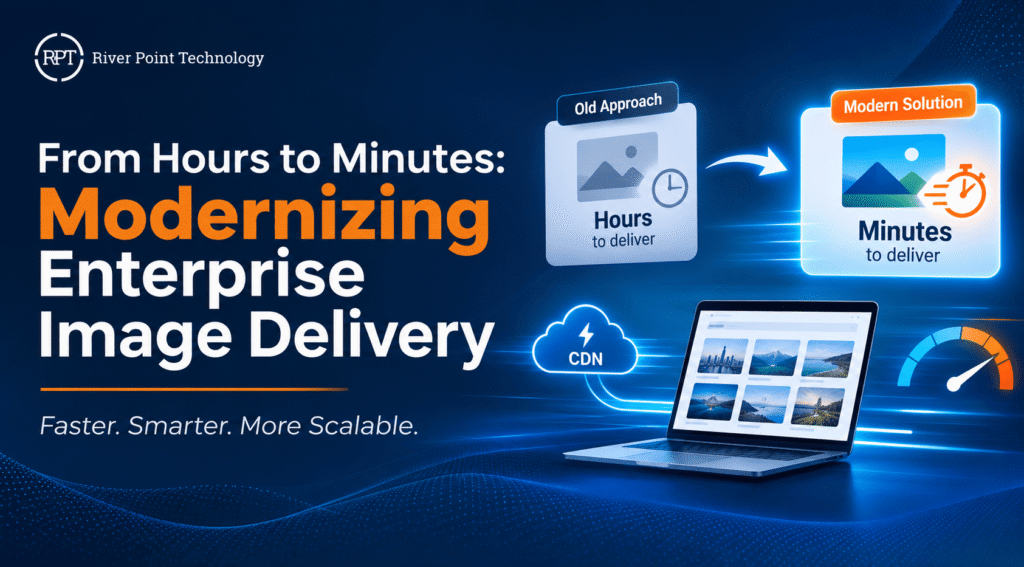
The impact extended beyond the platform team. Other groups began developing separate tools and partially automated processes to get their work done. One team’s image release cycle took a month. VM build requests typically took four to nine hours to fulfill, while certain network builds and virtual appliances required manual work and could take two weeks.
For enterprise teams, this kind of fragmentation affects more than turnaround time. When each group follows a different path to build and deliver images, the organization has fewer shared conventions to rely on as new platforms are introduced. The challenge is to give teams room to configure what they need without forcing every team to maintain its own tooling and process.
The solution: a standardized, flexible image factory
River Point Technology (RPT) was engaged to modernize the image-building process. Within months, RPT delivered a streamlined, operating-system-agnostic pipeline built on established tools, including HashiCorp Packer, Jenkins, Ansible, and JFrog Artifactory.
The approach balanced consistency with flexibility. Platform teams could create updated, compliant base images, while application teams could onboard and add the configurations they needed without building a separate image-delivery process from scratch.
Under the new model, onboarded teams can start with a templatized repository containing a Jenkins pipeline, Packer templates, and Ansible files. Teams that need greater control can customize their image-building workflows; teams with simpler requirements can use standard templates and supply their own configuration variables. Shared settings remain centrally managed, helping the organization maintain a consistent foundation across different use cases.
The pipeline also captured build metrics, metadata, and package inventories, improving visibility into what was built and supporting more consistent maintenance and troubleshooting.
The technical workflow also supports traceability. Build records capture timing, status, and other useful details, while software inventories and image lineage help teams understand what an image contains and which base image it came from. These capabilities give platform teams more context for troubleshooting and for identifying images that may need attention when a security issue arises.
The outcome: faster delivery and less fragmentation
The modernized approach replaced a patchwork of team-specific processes with a more standardized, scalable model. Application teams gained a clearer path to creating images, while platform teams could support them through shared automation and governance.
One especially notable result: VM deployments that previously sat within a broader, time-consuming delivery process now take approximately 20 minutes. Before the engagement, typical VM build requests took four to nine hours.
What this means for enterprise platform teams
As infrastructure environments grow, homegrown automation can become a bottleneck if it is difficult to maintain or adapt. This engagement illustrates how platform engineering and infrastructure automation can help organizations reduce fragmentation, establish reusable standards, and make delivery more predictable—without removing the flexibility application teams need.
The broader lesson is that modernization doesn’t always require building custom solutions. In this case, RPT helped replace a homegrown application with established, industry-standard automation tools and a reusable delivery approach. This shift reduced reliance on custom-built processes, improved maintainability, and established a more consistent foundation for infrastructure delivery. Standardization gave application teams a more predictable starting point, while the ability to customize preserved the flexibility required across different systems and environments.
RPT helps organizations modernize complex infrastructure workflows with practical automation, scalable platform practices, and an emphasis on operational outcomes.
Looking to simplify image delivery or modernize your infrastructure automation? Connect with the River Point Technology team to discuss your platform engineering challenges.